Mystery, Media, and the Making of a Cultural Myth
The late 1960s were turbulent in northern California. Politics, culture and the media all contributed to a feeling of turmoil and powerlessness. In this era people felt they were exposed to uncontrollable forces beyond their understanding. Citizens had little to no control over events happening elsewhere and mostly relied on newspapers to communicate with distant happenings.
Crimes were also reported in the media for more than just an informative purpose. It was meant to shock, frighten and engage the reader. Here the Zodiac Killer as a person is not only the man that did the deeds, but also the culmination of all the information and feelings the media and the public generated towards him. When referring to methods of communication employed by the Zodiac, it is essential to consider writing letters and coded messages as a prominent technique.
These acts transformed violent crimes into a large scale media event unlike anything previously experienced in the United States. Rather than presenting the Zodiac killings as a chronological narrative moving toward capture, this exhibit approaches the case through a synchronic analysis that focuses on meaning created within a specific historical moment. This perspective is achieved by examining the handwriting of Zodiac letters, coded messages reproduced in newspapers, and headlines that fueled mystery and spectacle. The public became participants when they attempted to solve cryptograms and debated theories circulating through the media.
These artifacts are not simply remnants of crimes but objects connected by a shared theme. The Zodiac remained unseen and unidentified, allowing the public to construct its own understanding of the killer. Letters directed toward newspapers provoked emotional responses while cryptograms functioned as puzzles inviting participation. The delay between publication and attempted solutions created uncertainty and curiosity.
Media repetition sustained suspense by revisiting the same limited information rather than providing resolution. As a result, the narrative surrounding the Zodiac became more compelling than any definitive solution. This exhibit includes samples of cipher texts, handwritten letters, and newspaper reporting. Each artifact represents a moment in which the Zodiac communicated with the public.
When viewed together, these materials demonstrate how media transformed acts of violence into a shared spectacle that captivated Northern California. Every crime started to look like a new scene in an unending movie. There was never a finale that brought the story to a conclusion. Fear is a concept that can be distributed, described and narrated.
The Zodiac killer was the man who committed the murders, but he was also an object of fear. This series does not focus on the individual and the unsolved murders, but rather the mystery, the media and the multitude of tales that formed the character of the Zodiac Killer, who gradually evolved into a legend, and is now one of the most popular and enduring in the history of American pop culture.
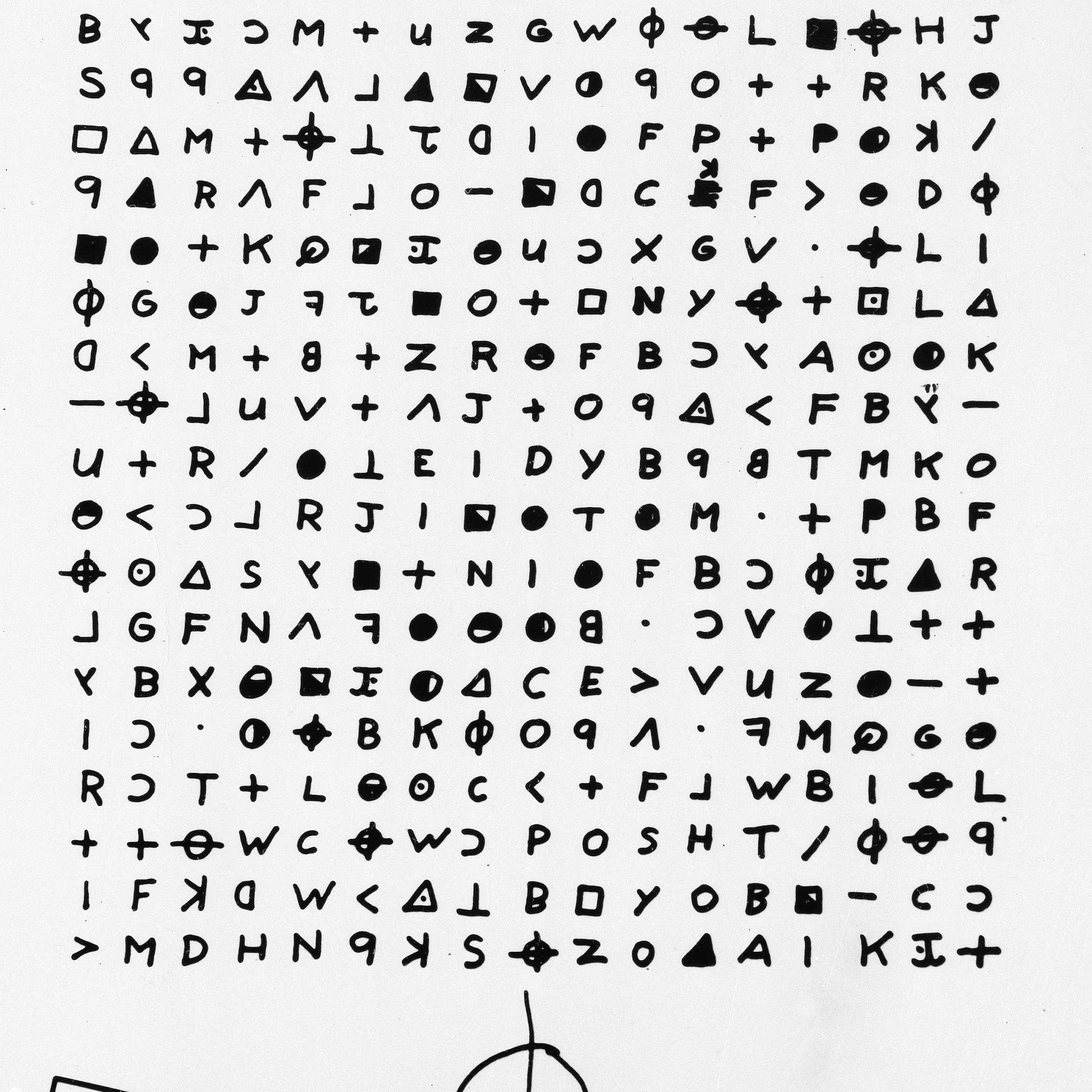
The 340 Character Cipher
The 340 character cipher is another example of the Zodiac Killer using the codex to engage the public. When the cipher was printed in the papers, many people had a go at trying to decipher it. They were drawn into the drama of the puzzle because they felt that they might be able to crack it.
None of the solutions they came up with were correct, although it would be hard to say without the aid of modern computer decryption techniques. Again, the cipher illustrates the use of cryptograms to continue the dialogue between the killer and the authorities, and the authorities and the public. It is also a prime example of the puzzles contribution to the Zodiac’s legend, by giving the public a role in the drama of the cryptogram.
It not only acted as a puzzle, but also as a challenge, and by including the public in the act, it increased the killer’s legend.
Handwritten Letters
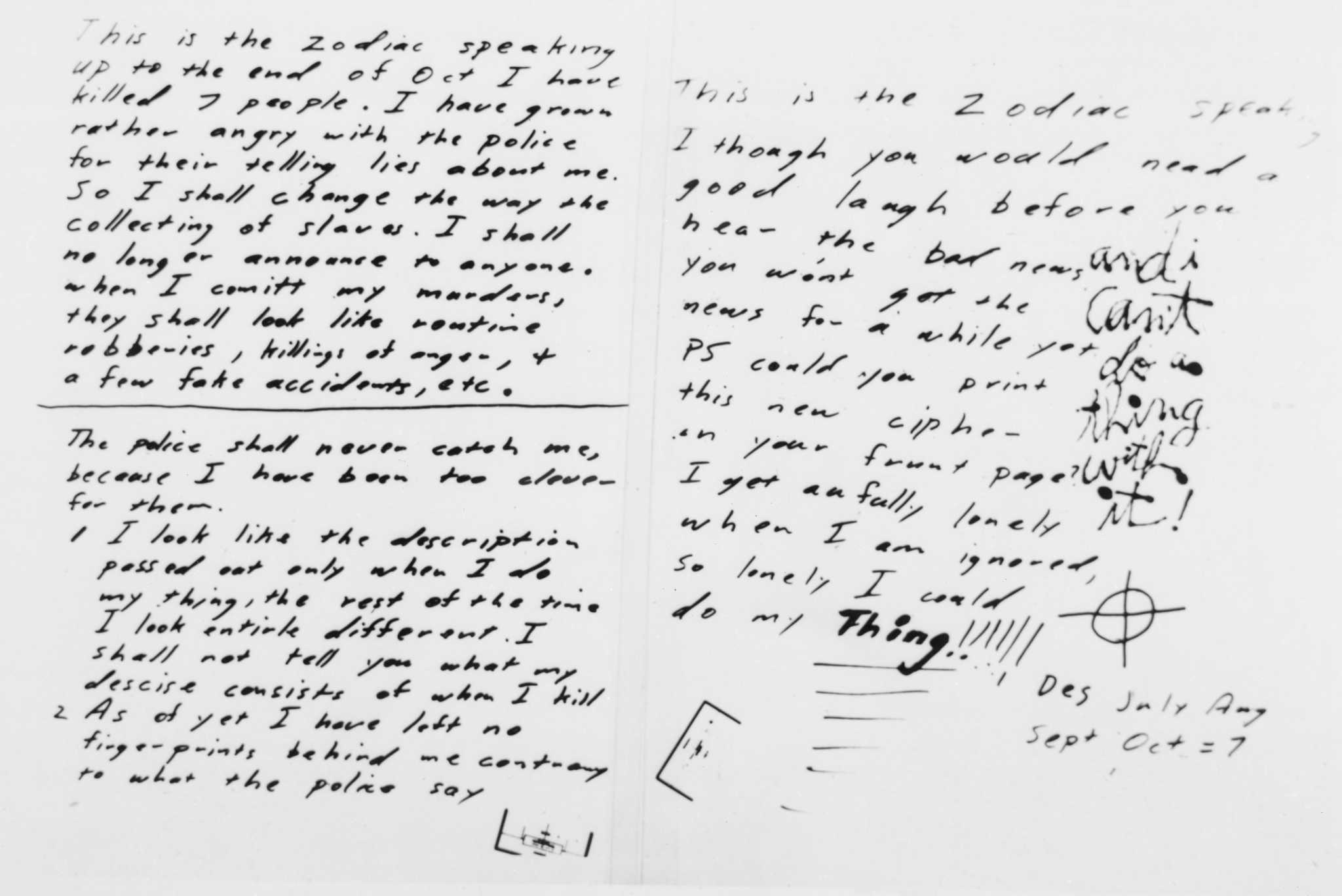
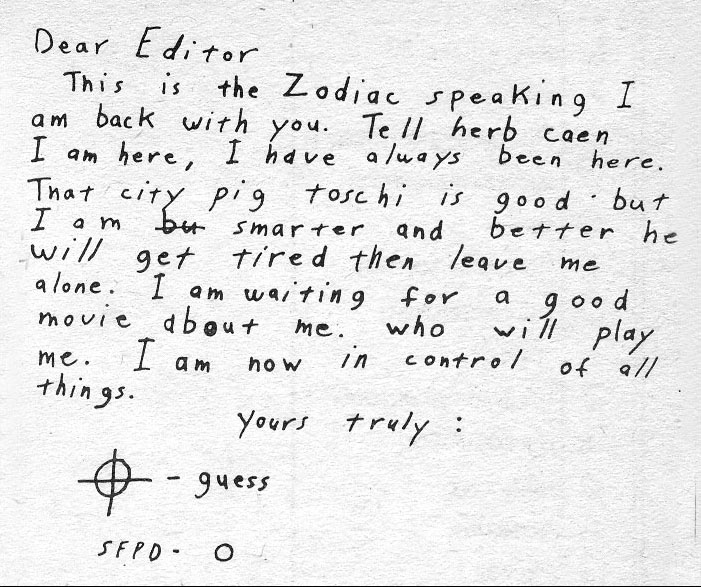
The handwritten letters illustrate how the Zodiac constructed a public persona through communication. Written in a casual tone, the letters addressed newspapers and readers directly while demanding publication. The Zodiac ensured maximum visibility by requesting widespread circulation.
Threatening language combined with limited factual information encouraged speculation about motive and identity. The letters maintained public fascination even during periods between crimes. Communication allowed the Zodiac to remain present within public consciousness regardless of investigative progress.
The letters also demonstrate how storytelling evolves through repeated communication. By withholding concrete evidence, the Zodiac sustained mystery and encouraged interpretation. Readers attempted to understand intent, personality, and meaning through limited information.
The absence of clarity strengthened engagement and allowed the narrative to expand through public discussion.
Newspaper Coverage and Media Circulation
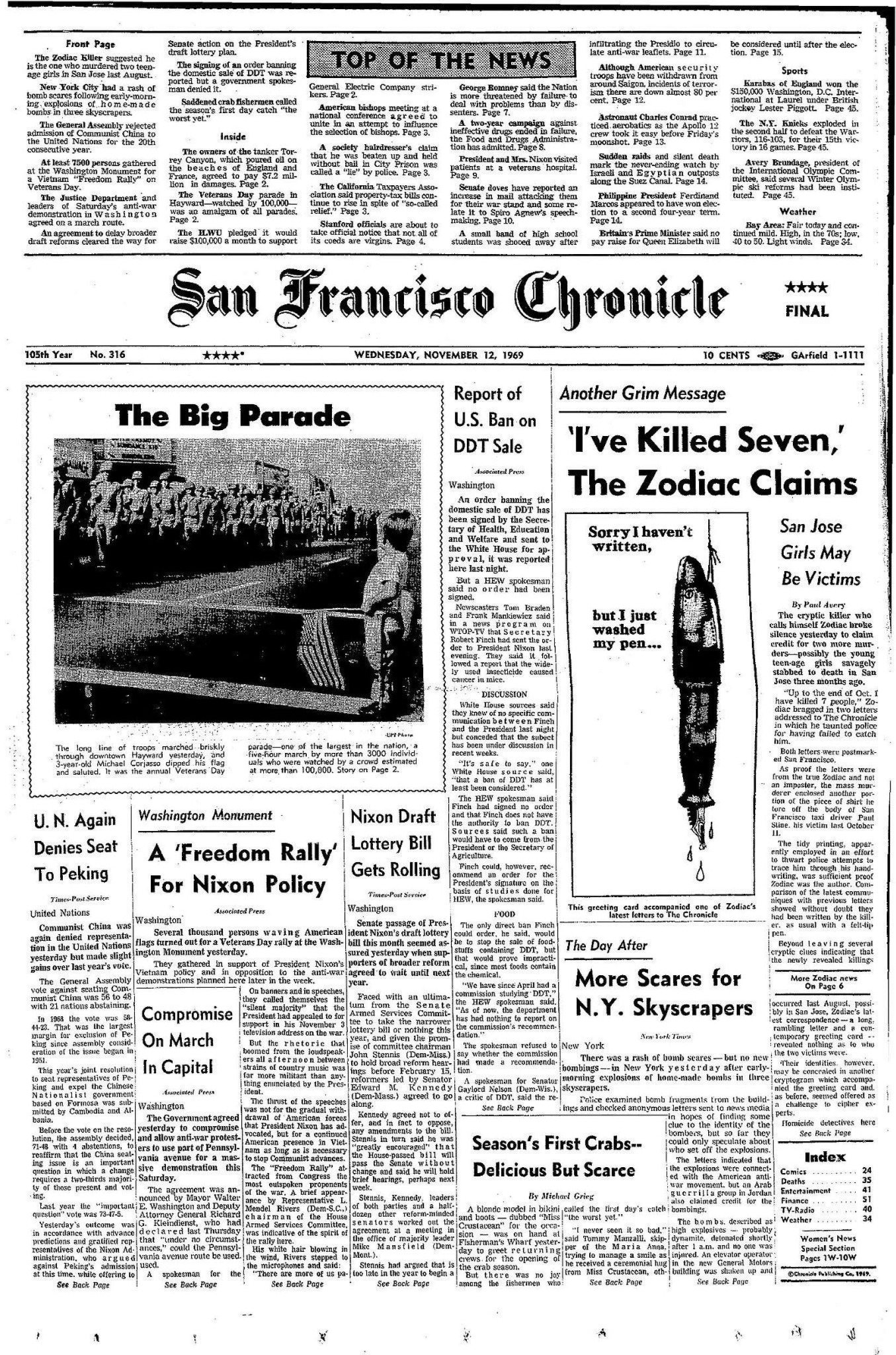
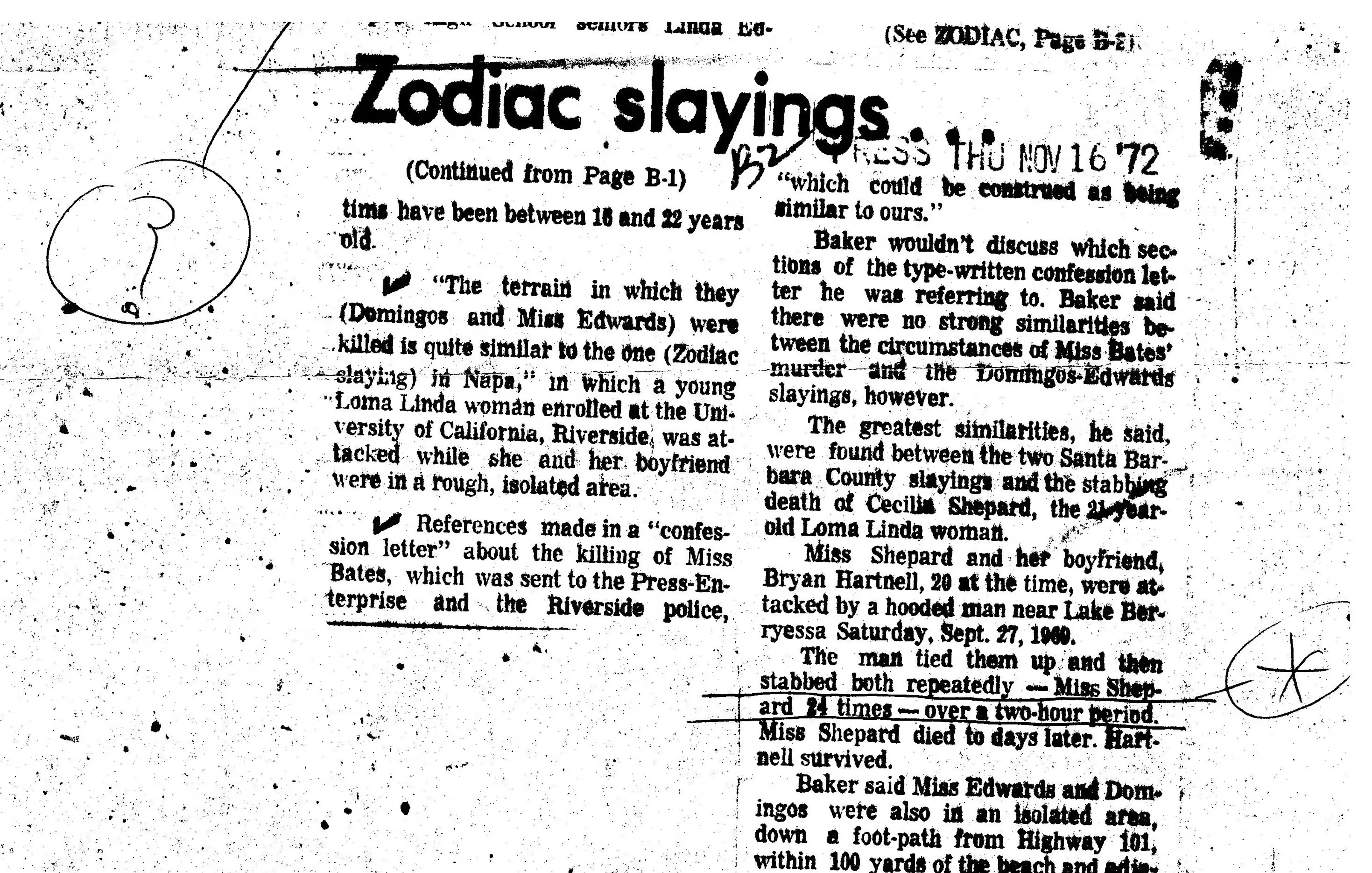
Newspapers keep the Zodiac legend alive. They report tips, leads, cryptograms and photos and give the killer intermittent coverage over the years. Without ever truly clearing up the mystery, each new revelation simply reopens the debate about the unsolved questions.
The papers report the events from day to day and make the ongoing serial killer business look like a TV drama, with the public as the audience and captive to the ongoing suspense of it all. As the cryptograms are printed and the public is arguing about possible solutions to them, the individual murders get swallowed up in the cultural debate about the symbolism. This exhibit also highlights the role of the public in the efforts to find clues.
Many people, including amateurs, tried to break the codes published in the press. The newspapers were full of suggestions and tips from the public, who all hoped to be the first to come up with a solution. Participation extended beyond law enforcement and created emotional investment among readers.
The opportunity to contribute to solving the mystery became a source of fascination. The use of cryptograms within crime reports helped elevate the Zodiac into an icon of popular culture. Continued decoding attempts sustained interest even in the absence of definitive evidence.
Storytelling and Cultural Memory
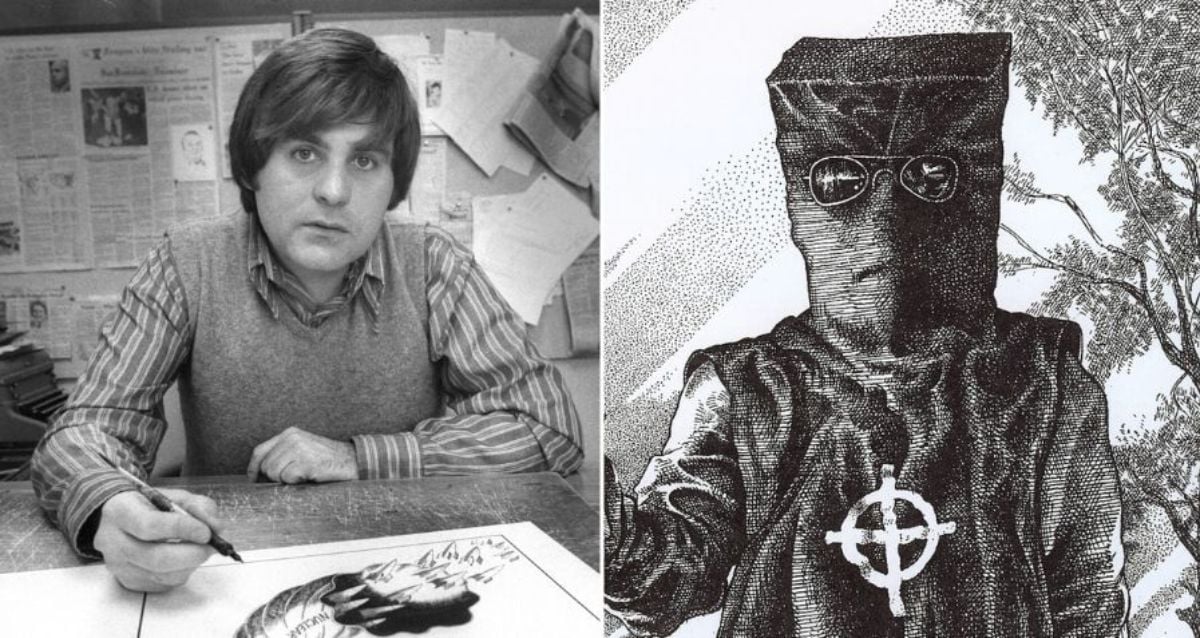
Storytelling itself functions as an informational artifact that extends events beyond their original moment. Newspaper illustrator Robert Graysmith witnessed the unfolding case and later retold it through narrative form centered on intrigue and uncertainty. His storytelling preserved public focus on the Zodiac long after the crimes occurred.
By presenting the case as an unresolved story rather than a concluded investigation, Graysmith contributed to the continued cultural life of the Zodiac myth.
The Unknown Identity
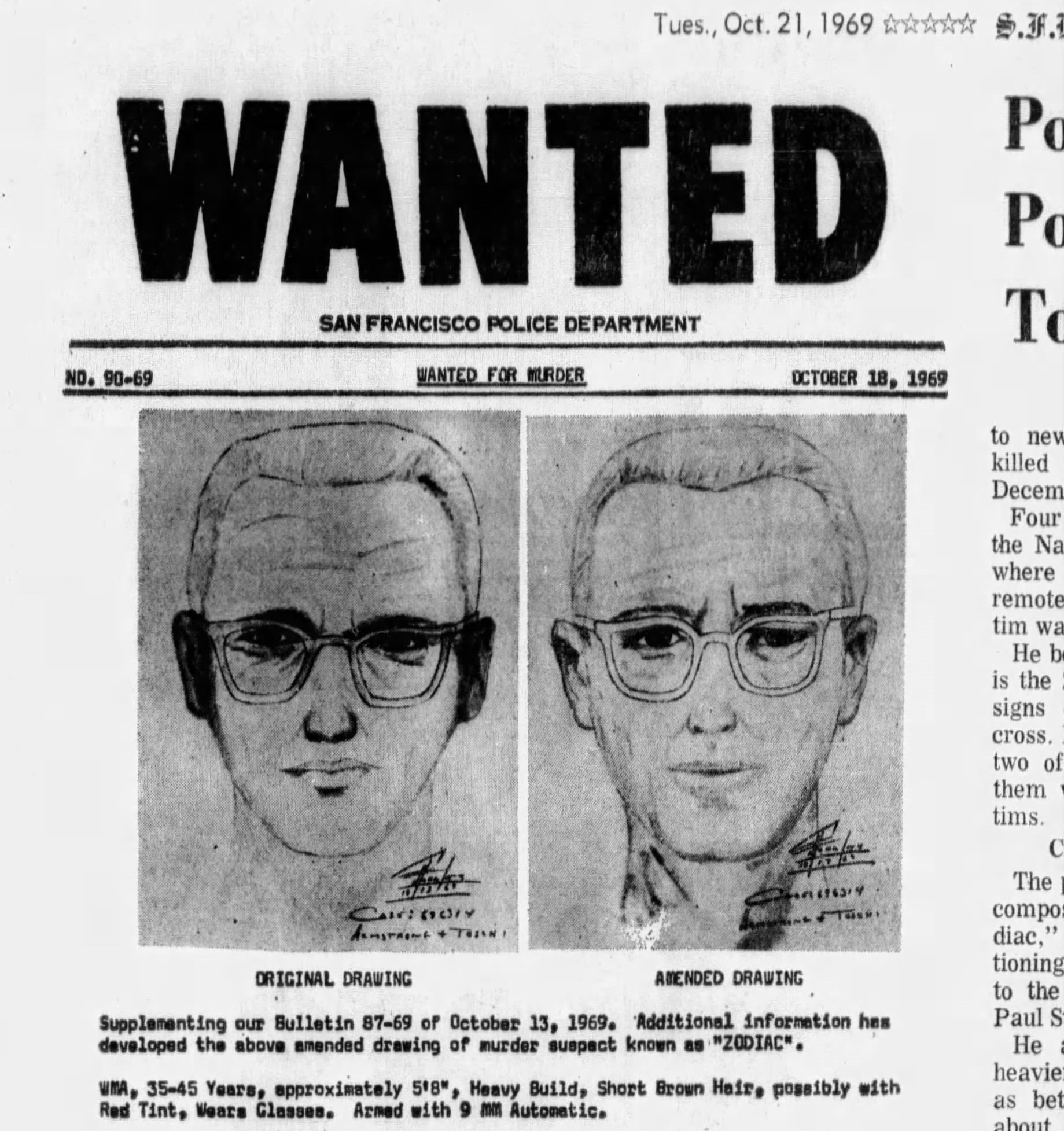
Perhaps the most lasting characteristic of the Zodiac case is the absence of confirmed identity. The unknown nature of the killer allows continuous reinterpretation. Competing theories ensure that the Zodiac remains open to multiple meanings.
Individuals can construct their own understanding of the figure, which sustains its symbolic power. The effect of not knowing has allowed the Zodiac to maintain cultural relevance far beyond the historical moment in which the crimes occurred. Historical influence is often associated with identifiable outcomes and resolutions.
In contrast, the influence of the Zodiac arises from communication, engagement, and narration. The artifacts presented in this exhibit demonstrate how letters, cryptograms, and newspaper coverage invited public participation. Through these interactions, audiences were drawn into a shared narrative shaped by mystery and interpretation rather than certainty.
Closing Reflection
The Zodiac Killer case stands out in American history because of the way the public interacted with it. My exhibit shows that the lasting impact of the Zodiac did not just come from violence. It came from communication, uncertainty, and public involvement. The Zodiac created a situation in which ordinary people felt connected to an unfolding mystery.
Readers were not simply learning about events after they happened; they were participating and attempting to figure out what was next on the psychotic agenda. One major idea brought to light by the case and the artifacts is that unanswered questions can sometimes hold more power than answers. Because the Zodiac was never identified, the story never truly ended. The letters and ciphers allowed for a continuous conversation throughout the period, keeping the story alive in the public eye.
As time went on, the Zodiac shifted from a mere criminal to an idea that was entirely shaped by the media. Looking back at this, it’s easy to see why the story and ideas still live on today. Modern true crime emphasizes a pattern of encouragement towards the audience in creating their own views and conclusions. This proves the Zodiac case can be attributed as one of the earliest examples of how the media transforms events into lasting stories.
Ultimately, my exhibit shows that the legacy of the Zodiac, and cases like it, exist because of the audience. The case combined mystery, fear, curiosity and imagination; this allowed for the creation of the “myth” that we know today and left a lasting impact on how the media can interpret and influence crime.
Artifact Resources
The Zodiac Cipher
“The Solution of the Zodiac Killer’s 340 Character Cipher.” Wolfram Blog, 24 Mar. 2021, https://blog.wolfram.com/2021/03/24/the-solution-of-the-zodiac-killers-340-character-cipher/. This article documents the decoding of the Zodiac’s 340 character cipher while preserving its original structure and historical context. The cipher stands as one of the main elements of my project because it demonstrates how the Zodiac creator forced people to solve his violent puzzle which he made impossible to understand. The public kept their interest in the project because it operated under a hidden agenda which did not directly reveal its actual purpose. The artifact shows how people maintained their interest in the Zodiac case throughout multiple decades because it allowed viewers to become involved in solving the mystery which transformed the Zodiac into a symbolic figure instead of finding his criminal evidence.
Zodiac Killer Letters
Zodiac Killer Letters. Archive.org, https://archive.org/details/ZodiacKiller/Zodiac1/page/n29/mode/2up. The digital archive contains scanned versions of Zodiac handwritten letters which enable researchers to study his writing methods and his methods of presentation. The letters prove essential because they demonstrate how the Zodiac maintained public interest through their confusing statements which avoided giving direct answers. The authors employed their taunting method to generate reader speculation instead of driving them away from the content. Further showing how people in the public domain transformed the Zodiac into a mythological figure through their direct communication and their inability to provide answers about him.
Newspaper Articles on the Zodiac Killer
“Newspaper Archive Index.” ZodiacKiller.com, https://www.zodiackiller.com/newspaper_archive_index.html. The archive contains newspaper articles about the Zodiac case which demonstrate how journalists kept the story alive through continuous coverage despite the lack of significant developments. The articles presented new letters and ciphers and threats instead of solutions which created more confusion for readers. The artifact proves useful because it shows how media organizations kept their viewers engaged through their practice of asking questions during their shows. The articles demonstrate how journalists used their reporting to create a cultural icon out of the Zodiac case by linking public interest to the enigmatic nature of the killer.
Secondary Sources
“This Is the Zodiac Speaking: Psychological Profiling.” Dark Minds, Deadly Deeds, CSI Pressbooks, https://csi.pressbooks.pub/darkmindsdeadlydeeds/chapter/this-is-the-zodiac-speaking-psychological-profiling/.
The source examines the Zodiac by using psychological assessment methods to study his communication methods and his reasons for acting and his typical behavioral responses. The text explains how the Zodiac achieved his goals through his letters and puzzles instead of revealing his identity as the murderer. The research evidence demonstrates how psychological manipulation together with ambiguous information led people to participate in public discussions. The audience developed such strong interest in the story that they started to view the Zodiac as a cultural icon instead of focusing on solving his murders.
Beeson, Drew H., and Deneen M. Shreve. “Deciphering the Zodiac Killer: A Killer Betrayed by His Own Words.” Journal of Scientific Exploration, vol. 39, no. 3, Fall 2025, pp. 301–318, https://doi.org/10.31275/20253043.
The research in this peer-reviewed article investigates how the Zodiac's written messages affected both police work and how the public understood the case. The authors establish language as the core element of meaning creation through their analysis of letters and ciphers as purposeful communications instead of random findings. Users maintained their interest through puzzle activities and word combination tasks and unclear content. People created a myth from the case through their individual interpretations because of communication breakdowns and uncertainty which resulted in the Zodiac gaining cultural significance.
Barthes, Roland. “Myth Today.” Mythologies, translated by Annette Lavers, Hill and Wang, 1972. Marxists Internet Archive, https://www.marxists.org/reference/subject/philosophy/works/fr/barthes.htm.
Barthes describes how myths develop through the process of repeated symbol use which removes events from their original setting to create cultural significance. The framework demonstrates how the Zodiac case evolved into a criminal case which continues to haunt society because it remains unsolved and keeps appearing in public discourse. Barthes demonstrates how letters and puzzles and headlines transform unidentifiable data into significant stories. The source demonstrates how the Zodiac achieved cultural status because of its recurring patterns and mysterious aspects which drew supporters who dismissed all evidence.